
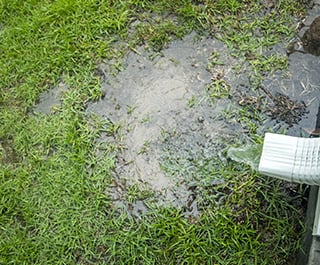
Good yard drainage is one of those things you don’t think about much until you have a problem. Then suddenly you’re watching water pool in your lawn after every rain, noticing erosion along your garden beds, or finding that your basement is a little damper than it used to be. If you’ve started looking into solutions, you’ve probably come across two names: French drains and swales. Both can do a lot of good, but they work differently, and the right choice really depends on what your property is dealing with. We’ve been solving drainage problems for homeowners and businesses across Montgomery County and NW DC since 1981, so let us break this down in plain terms.
What Is a French Drain?
A French drain is a subsurface system, meaning it works underground. It’s essentially a trench filled with gravel and a perforated pipe that collects water from the surrounding soil and carries it away from your home or yard to a designated outlet. Because it’s buried, it’s largely invisible once the job is done, which many homeowners appreciate.
French drains tend to be a strong fit when the drainage problem is happening beneath the surface. If water is saturating your soil, seeping toward your foundation, or causing soggy spots that don’t seem to have an obvious surface source, a French drain is often the right tool. We install them frequently in neighborhoods like Chevy Chase, Kensington, and Wheaton, where older homes sometimes sit on lots that were graded decades ago and no longer shed water the way they should.
The tradeoff is that French drains require more excavation and materials than a swale, which can make them a larger investment up front. They also need occasional maintenance to prevent the pipe or gravel from becoming clogged with sediment over time.
What Is a Swale?
A swale is a shallow, gently sloped channel cut into the landscape to redirect surface water. It’s an above-ground solution that works by guiding runoff across the yard and away from structures, usually toward a storm drain, a low area of the property, or a planted absorption zone. Done well, a swale can actually be a pleasant landscape feature, especially when it’s planted with native grasses or ground cover that stabilize the soil and add visual interest.
Swales work best when the issue is surface runoff rather than soil saturation. If you’re seeing water rush across your lawn during a downpour, collecting against your fence line, or channeling into a neighbor’s yard, a swale may be exactly what you need. We see this situation often in Takoma Park and Silver Spring, where lots with slight grades can send water in all the wrong directions during a heavy storm.
On the cost side, swales are generally less expensive to install than French drains because they don’t require buried pipe or deep excavation. That said, they do need to be graded precisely. A swale that’s off by even a small amount can create new problems rather than solving the existing ones.
How Do You Know Which One You Need?
Here’s a simple way to think about it. If the water is coming up from below or sitting in the soil long after rain has stopped, look at a French drain. If the water is running across the surface and going somewhere it shouldn’t, a swale is worth considering. And in some cases, the best solution is actually a combination of both, with a swale handling surface runoff and a French drain managing what soaks into the ground.
A few other factors matter too:
- Lot size and grade: Larger or more steeply sloped properties often benefit from swales, while tighter, flatter lots may need the precision of a buried system.
- Proximity to structures: The closer the water problem is to your foundation, the more likely a French drain is part of the answer.
- Aesthetics: If keeping the yard looking natural is a priority, a well-planted swale can be beautiful. If you’d rather not see the drainage at all, French drains disappear into the landscape.
Homeowners in areas like Chevy Chase and Kensington often ask us about this combination approach, and it’s one we’re very familiar with after more than four decades of working on properties throughout Montgomery County and NW DC.
Getting It Right the First Time
Drainage work isn’t something you want to guess at. A solution that’s installed incorrectly can shift water toward your foundation, erode your soil, or create new wet spots elsewhere on the property. That’s why a proper site assessment matters before any digging starts. Our team of 30 lawn and yard experts takes the time to look at how water actually moves across your property before recommending anything, whether you’re in Wheaton, Takoma Park, or anywhere else in the area.
We’re licensed, insured, and have been trusted by this community for over 40 years. If you’re not sure which drainage solution fits your yard, we’re happy to help you figure it out. Give us a call or drop us an email, and we’ll take it from there.